Samsung Un24m4500 24 Class Smart M4500 Series 720p Led Hdtv With Wi-fi Reviews
Test Results
Pattern
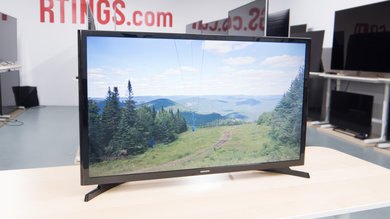
Curved No
The pattern of the M4500 is basic. It certainly won't stand out but is perfectly functional. It lacks some nice touches plant on the higher cease M5300 also (textured borders and metallic colored feet). The wide stand may make information technology more difficult to fit on a tabular array just does provide stable support.

The broad-set plastic stand up of the M4500 supports the TV well. It will wobble a bit if pushed, but is still quite stable.
Footprint of the 32" TV stand: 29.0" ten 5.eight"

Wall Mount VESA 100x100
The rear of the TV is simple and very like to the slightly higher terminate M5300. Information technology supports VESA for wall mounting which is practiced, however, some of the inputs directed out the back may be hard to access.

Borders 1.ten" (2.8 cm)
The M4500 has some of the thickest borders of whatsoever TV we've tested. They are made of shiny plastic which does attract fingerprints too.

Max Thickness 2.68" (6.viii cm)
The Television set appears adequately thick when viewed from the side. Information technology will stick out a bit when wall mounted.
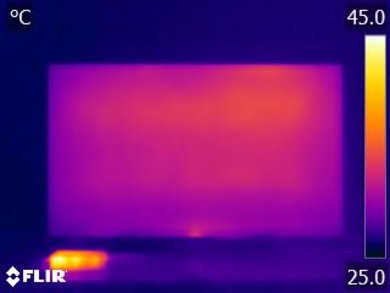
Maximum Temperature 95 °F (35 °C)
Average Temperature 90 °F (32 °C)
The Television stays fairly cool, likely because information technology'southward not very brilliant. The power brick, on the other hand, reaches a maximum of 44 °C, which feels warm to the manus but isn't too hot to touch.

The build quality of the M4500 is fine. It is entirely plastic and does experience quite cheap but this is unlikely to cause any bug with normal utilize.
Picture Quality
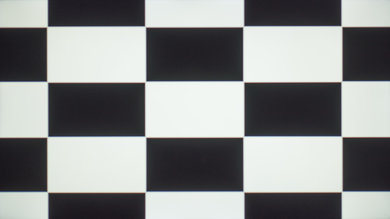
Native Contrast 4,593 : 1
Contrast with local dimming N/A
The Samsung M4500 has an excellent native contrast ratio. With over 4500:1, the M4500 can brandish really deep black, which is perfect for a dark or very dim home theater room. Night scene in movies are well detailed and overall, this high dissimilarity ratio is benign to most content.
Local Dimming No
Backlight Direct
The Samsung M4500 does non have a local dimming characteristic. The video is for reference merely.
SDR Real Scene Elevation Brightness 205 cd/m²
SDR Pinnacle 2% Window 141 cd/m²
SDR Peak ten% Window 252 cd/m²
SDR Tiptop 25% Window 250 cd/m²
SDR Tiptop 50% Window 249 cd/m²
SDR Peak 100% Window 249 cd/m²
SDR Sustained 2% Window 140 cd/chiliad²
SDR Sustained x% Window 245 cd/m²
SDR Sustained 25% Window 244 cd/1000²
SDR Sustained 50% Window 243 cd/m²
SDR Sustained 100% Window 243 cd/m²
SDR ABL 0.039
Plot over time
Mediocre SDR tiptop brightness, proficient plenty for a moderately lit room but not bright enough for a bright room. The Goggle box's CE dimming dims the picture during very dark scenes, as shown past our two% white window test, but otherwise the brightness remains fairly consistent. Overall the effulgence is a little less than virtually of the M4500's competitors like the Samsung M5300, the TCL D100 and the LG LJ5500; simply all the same brighter than the value leading TCL S305.
HDR Real Scene Peak Brightness N/A
HDR Peak two% Window N/A
HDR Peak 10% Window N/A
HDR Summit 25% Window N/A
HDR Peak fifty% Window North/A
HDR Peak 100% Window N/A
HDR Sustained 2% Window N/A
HDR Sustained 10% Window Northward/A
HDR Sustained 25% Window N/A
HDR Sustained 50% Window N/A
HDR Sustained 100% Window N/A
HDR ABL North/A
HDR is not supported.

50% Std. Dev. 5.302%
50% DSE 0.230%
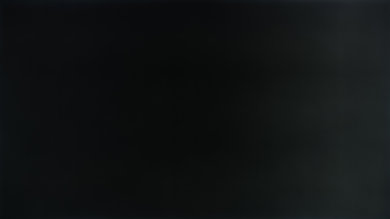
v% Std. Dev. 3.048%
5% DSE 0.133%
The M4500 gray uniformity is disappointing. Most of the uniformity issues are from the corners beingness darker than the center of the screen and the top and bottom edges being a scrap brighter. Some faint vertical lines are likewise visible and the correct side of the screen is also a bit brighter than the left side. Unfortunately, dirty screen upshot is visible when watching normal content, especially sport like hockey or football.
Looking at the 5% gray test picture, the uniformity is a flake better than on the 50%, only some of the issues noticed before on the l% are notwithstanding visible hither, especially the brighter top and bottom edge, and also the right side of the screen being brighter than the rest of the screen.
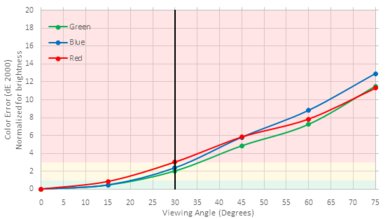
Color Shift thirty°
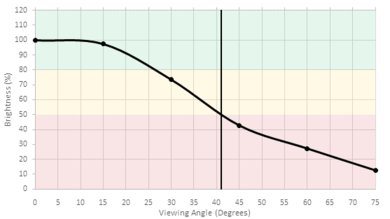
Brightness 41°
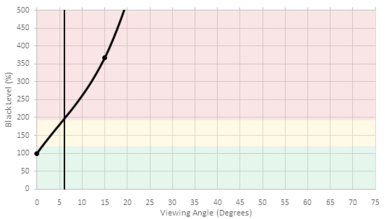
Black Level 6°
Bad viewing angle, but fairly typical for a TV with a VA console. Dark shades wash out rapidly at an angle, while colors and brightness aren't badly degraded until viewed from moderate angles. Overall, this Television receiver isn't well suited for a room where people often sit to the side of the TV and view it at an angle.
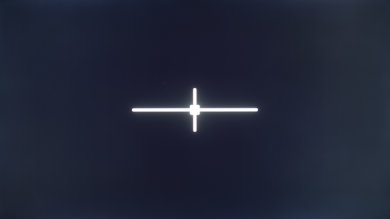
Native Std. Dev. 2.193%
Std. Dev. w/ L.D. N/A
The black uniformity of the M4500 is sub-par. Similarly to what was noticed on the gray uniformity test, the right side of the screen is brighter than the residual, and the top and lesser edge are besides a bit brighter.

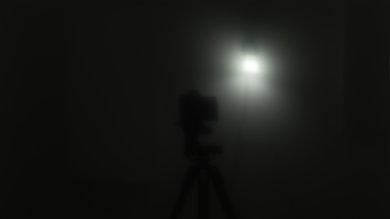
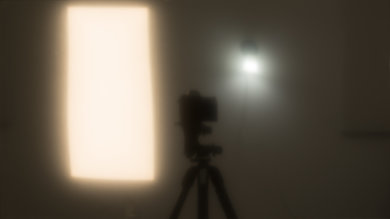
Screen Finish Semi-gloss
Full Reflections 5.0%
Indirect Reflections 0.3%
The M4500 is decent at handling reflections. Similar to most other TVs is has a semi-gloss finish which diffuses reflection beyond the screen and reduces their intensity. This is fine for an average or night room, but in a brilliant room, the reflections volition be distracting.


Picture Style Flick
White Balance dE 5.09
Color dE iv.57
Gamma 2.49
Color Temperature 5,734 K
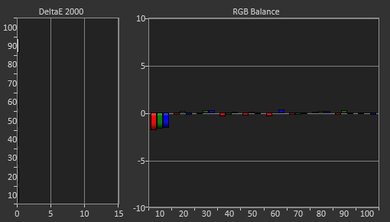
Out of the box, the accuracy of the Samsung M4500 is disappointing. The white residual dE and color dE are high enough so that pretty much anyone could notice the inaccuracy. The gamma is well above our 2.2 targets and looking at the gamma bend, we see that it is off target, particularly in the lower IRE (nighttime), which could impact the night scene in movies, causing night vanquish.
Color-wize, the primary cause of problems of the M4500, is the fact that the white points drifter toward the warm color and all the rest of the colour likewise drifting in the same management.

Moving-picture show Mode Movie
White Balance dE 0.xviii
Colour dE 2.12
Gamma two.20
Colour Temperature 6,521 Thou
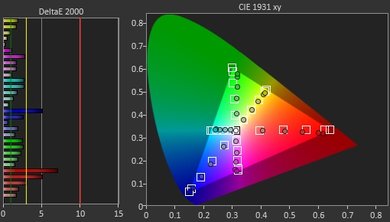
Later calibration, the accuracy of the M4500 is much meliorate. The white balance was greatly corrected and after calibration has a dE of but 0.18, which is non noticeable even by professional. On the colour side of thing, the dE was cutting past half, but the dE (2.12) is however loftier enough that a professional who is used to work with calibrated TV would find the inaccuracy, merely for most people, it should be good enough.
Every bit for the gamma, the gamma is now correct on target (2.ii) and the curve is non almost flat, which is much better than what it was earlier calibration.
You can see our calibration settings here.

Upscaling of 480p content such every bit DVDs is good. The image is slightly soft but still remains fairly detailed and very few artifacts are visible.

Hard disk content such as 720p cablevision is upscaled well. The 1366x768 native resolution of the TV doesn't quite match the 1280x720 resolution of most cablevision, so the image is slightly blurry because it can't practise 1-ane mapping. This is not very noticeable though.
Although the TV is able to take a 1080p input, information technology cannot display information technology without downscaling to 1366x768. If your source tin can't output 1366x768, then the 1080p input is useful for loftier-quality content to avert downscaling to 720p, then upscaling to the TVs native resolution which results in some loss of item compared to just downscaling steps.
A 4k input isn't supported.
Broad Color Gamut No
DCI P3 xy 62.82%
DCI P3 uv 72.57%
Rec 2020 xy 45.07%
Rec 2020 uv 52.89%
Mediocre color gamut, even for a Goggle box without HDR. The Tv set can't fifty-fifty encompass the entire SDR Rec 709 color space, and so fully saturated colors will be shown a trivial less saturated than intended.

Normalized DCI P3 Coverage ITP 54.9%
10,000 cd/1000² DCI P3 Coverage ITP 13.five%
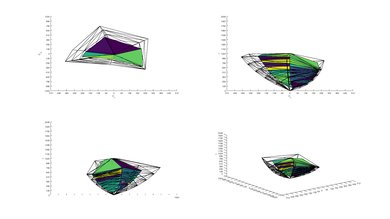
Normalized Rec 2020 Coverage ITP 39.five%
ten,000 cd/m² Rec 2020 Coverage ITP 9.7%
Bad color book, but mostly limited by the TV's mediocre colour gamut. The TV makes skilful use of the gamut it does take by extending information technology well to a range of brightness levels, though saturated blood-red and blue can't get quite as vivid as they should.
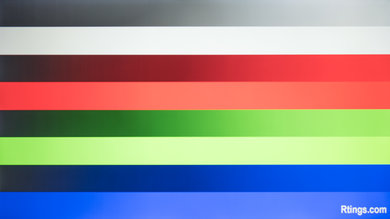
Color Depth x Scrap
Red (Std. Dev.) 0.112
Dark-green (Std. Dev.) 0.120
Blue (Std. Dev.) 0.100
Grayness (Std. Dev.) 0.147
The M4500 is skilful at displaying our gradient exam prototype, better fifty-fifty than many pricier Samsung TVs like the MU8000. The M4500 is capable of displaying a 10 bit slope, which is strange for an SDR-only TV simply is very welcome. Some banding problems tin can exist seen in the darker areas of the photo, only this is fairly typical for ten flake TVs, and will pose no problem when watching SDR content.
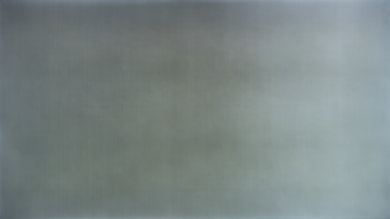
IR subsequently 0 min recovery 0.00%
IR after 2 min recovery 0.00%
IR later 4 min recovery 0.00%
IR after six min recovery 0.00%
IR afterward eight min recovery 0.00%
IR subsequently 10 min recovery 0.00%
The M4500 does not suffer from temporary image retention, as we did non find any image remnant from the burn-in scene, even correct after the 10 minutes exposure.
Permanent Burn down-In Risk No
We don't expect VA panels to feel permanent image retention, as the VA panel in our long-term test appears immune.
Motion

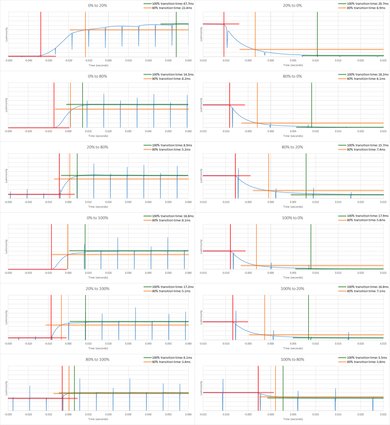
80% Response Fourth dimension vii.five ms
100% Response Fourth dimension 18.8 ms
Proficient pixel response time, proficient enough for watching fast moving content like sports. Most of the blur in the photograph is due to backlight flicker; only a brusque ghosting trail can exist seen following the moving logo cheers to the adept response time. The motion blur is similar to competing TVs like the TCL S305 and the LG LJ5500, but not quite as good as the Samsung M5300 because of its effective use of pixel overdrive.

Flicker-Gratuitous No
PWM Dimming Frequency 120 Hz
The TV has backlight flicker that is always present, but is less noticeable at higher brightnesses. This is because the TV dims its brightness merely by using PWM, which is, unfortunately, common in upkeep TVs. This flicker won't be too noticeable to most people, but may bother those sensitive to flicker. In terms of move, while this flickering does reduce persistence mistiness, it also causes double paradigm artifacts like seen in the photo in the Movement Blur box, which makes motion await less clear.
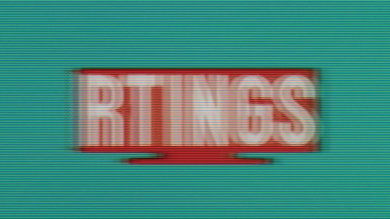
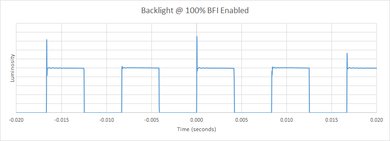
Optional BFI Yep
Min Flicker for 60 fps 120 Hz
lx Hz for sixty fps No
120 Hz for 120 fps N/A
Min Flicker for 60 fps in Game Style 120 Hz
While this Idiot box does have a black frame insertion setting (called 'LED Clear Motion'), all it does is reduce the TV'due south brightness so flickering is always present, and then it's useless. The Telly's 120 Hz PWM backlight does aid somewhat to make movement clearer, but not most as well as a TV that can flicker at threescore Hz, like the Sony X720E.
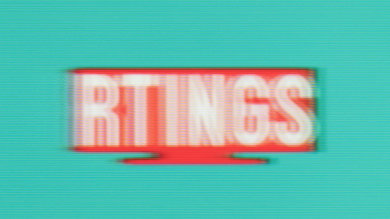
Motility Interpolation (xxx fps) Yes
Movement Interpolation (lx fps) No
The TV has a 60 Hz panel and can interpolate lower frame rate content up to its native 60 fps. However, because it doesn't have a 120 Hz panel information technology tin can't interpolate lx fps content up whatever higher, only this is expected of a budget Television set.
Frame Hold Fourth dimension @ 24 fps 22.9 ms
Frame Hold Time @ 60 fps 0.0 ms
This Television set is great at displaying videos without stutter, even for low frame charge per unit content such as movies. This is due to the response time, which smoothes the transition between frames.
Judder-Free 24p No
Judder-Complimentary 24p via 60p No
Judder-Costless 24p via 60i No
Judder-Free 24p via Native Apps No
Similarly to the M5300, the M4500 cannot remove judder from 24p movies playing from 24p, 60p and 60i sources. This ways that 24p movies, playing from any sources, will e'er display some judder. This is non a problem for everybody, as it is not everyone that is sensitive to judder. If you have watched movies on a mobile device before and did not notice whatsoever judder, y'all should be okay with the Samsung M4500.
Native Refresh Rate 60 Hz
Variable Refresh Charge per unit No
4k VRR Maximum N/A
4k VRR Minimum N/A
1080p VRR Maximum N/A
1080p VRR Minimum N/A
VRR Supported Connectors N/A
Similar most 2017 TVs, the M4500 doesn't support a variable refresh rate.
Inputs
1080p @ 60Hz 46.7 ms
1080p @ 60Hz + HDR N/A
1080p @ 60Hz Outside Game Mode 46.vii ms
1080p @ 120Hz N/A
4k @ 60Hz N/A
4k @ 60Hz + HDR Due north/A
4k @ 60Hz @ four:4:four Due north/A
4k @ 60Hz @ four:four:iv + 8 chip HDR N/A
4k @ 60Hz Outside Game Mode N/A
4k With Interpolation N/A
4k @ 120 Hz North/A
4k with Variable Refresh Rate Northward/A
1080p with Variable Refresh Charge per unit N/A
Decent input lag, adept enough for coincidental gaming but information technology may exist disappointing for more serious gamers. Strangely the input lag in 'Game' mode (63.three ms) was higher than out of game fashion when motion interpolation was off (46.7 ms), and so nosotros recommend using 'Movie' fashion with all processing disabled to go the all-time input lag. PC mode had the same input lag as out of game mode. This 'Game' mode bug was likewise seen with the Samsung M5300. Overall, the input lag is significantly worse than many competing TVs like the TCL D100 and S305, and the LG LJ5500.
1080p @ 60Hz @ four:iv:4 No
1080p @ 120Hz No
1440p @ 60Hz No
4k @ 30Hz @ four:4:iv No
4k @ 60Hz No
4k @ 60Hz @ four:4:four No
4k @ 120Hz No
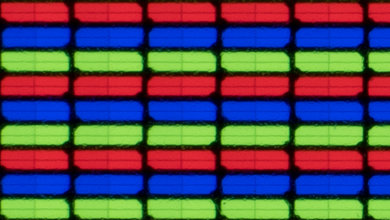
Because the TV just has a 1366x768 pixel panel, information technology can't prove 1080p or 4k content at full resolution. In PC mode the Idiot box can show 1366x768 with 4:4:4 color properly, which is practiced, but sometimes it gets stuck in a state where it won't bear witness four:4:four color properly and requires a hard plug pull to be corrected. PC mode is activated by setting the input's icon to 'PC'. 1360x768 is listed as the Tv'due south native resolution but 1366x768 is the true resolution of the panel, so nosotros recommend using 1366x768 whenever possible.


HDMI ii
USB 1
Digital Optical Sound Out i
Analog Audio Out iii.5mm 0
Analog Audio Out RCA 0
Component In ane (shared)
Blended In 1 (shared)
Tuner (Cable/Emmet) one
Ethernet 1
DisplayPort 0
IR In 0
SD/SDHC 0
HDR10 No
Dolby Vision No
HLG No
3D No
5.1 Passthrough ARC Dolby Digital Yes
5.ane Passthrough ARC DTS Yeah
five.i Passthrough Optical Dolby Digital Yeah
v.1 Passthrough Optical DTS Aye
HDMI two.0 Full Bandwidth No
HDMI 2.1 Full Bandwidth No
ARC Yeah (HDMI 2)
USB 3.0 No
HDCP two.ii No
CEC Aye
MHL No
Variable Analog Audio Out No
Wi-Fi Support Yes (two.4 GHz, v GHz)
For 5.1 passthrough only ane of Dolby Digital or DTS can be enabled at a fourth dimension, then y'all must manually switch between them depending on what your source supports.
Sound Quality
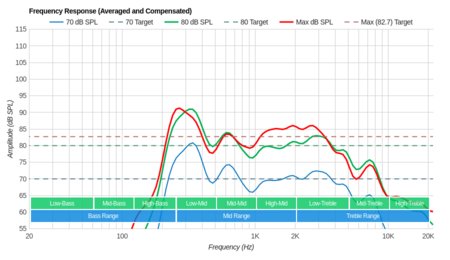
Depression-Frequency Extension 213.57 Hz
Std. Dev. @ 70 half-dozen.76 dB
Std. Dev. @ fourscore half dozen.67 dB
Std. Dev. @ Max 7.16 dB
Max 82.vii dB SPL
Dynamic Range Compression ii.69 dB
Bad frequency response. The M4500'south very small speakers are incapable of reproducing bass frequencies properly, leading it to sound quite thin. Combined with its relatively low volume and subdued treble, it makes for very unsatisfactory audio reproduction.
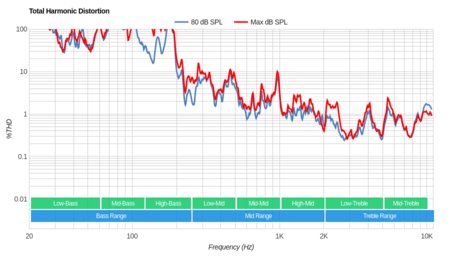
Weighted THD @ lxxx 0.341
Weighted THD @ Max 0.659
IMD @ lxxx v.92%
IMD @ Max thirteen.02%
Average distortion performance. The M4500'due south THD levels remain reasonable low across its book range. IMD is a little higher, peculiarly at maximum volume where some aliasing of higher frequencies can be heard.
Smart Features

Smart OS Tizen
Version 2017
Ease of Use Easy
Smoothness Average
Time Taken to Select YouTube 4 southward
Time Taken to Change Backlight five s
Advanced Options Many
The eye of the interface is the Smart Hub itself, which gives access to all the other sections; this makes the interface easy to navigate for get-go fourth dimension users. Luckily there are also 'Settings' and 'Inputs' buttons on the remote so users tin bound straight to those sections without passing through the Smart Hub, which saves fourth dimension. The interface has a lot of animations when browsing, only unfortunately those animations oftentimes stutter and jank, even worse than on most Samsung TVs.
Ads Yes
Opt-out No
Suggested Content in Dwelling house Yep
Opt-out of Suggested Content No
The TV did not bear witness ads during our testing, still, ads are oft inconsistent on Samsung TVs. It can be causeless that this TV has ads considering all Samsung TVs since 2016 accept had ads, and ads were visible on many 2017 Samsung TVs during testing such as the Q7F.
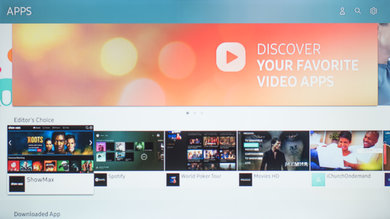
App Option Many
App Smoothness Average
Cast Capable Aye
USB Drive Playback Yes
USB Drive HDR Playback N/A
HDR in Netflix N/A
HDR in Amazon Video N/A
HDR in YouTube Due north/A
The TV comes preinstalled with most of the popular apps, such as Netflix, YouTube and Amazon Video. Many more apps can exist downloaded from the Samsung app store, which has more apps than about other smart platforms. Apps run fairly smoothly, but animations in apps sometimes have some stutter.

Size Medium
Vox Control No
CEC Menu Control Yes
Other Smart Features No
The TV comes with a bones remote without whatsoever smart features, and can't exist used with the smart remotes from other Samsung TVs. The remote is fairly light for its size and has a nice curve to its back, but its rubber clamper buttons aren't every bit easy to printing on some other remotes. One useful feature is that the buttons light up when pressed, which is handy in a dark room.

Acts every bit the Remote Yes
Directly Launches Apps and Inputs Apps Only
Inputs Text in YouTube No
Inputs Text in Netflix No
Streams Device Files Yeah
Controls TV Settings No
Vocalization Control No
The Samsung SmartView app has a few useful features such as streaming files from the app's device to the Tv but lacks some other features such as text entry. Also, the app can't be used for vox control with the M4500, different with most other Samsung TVs, probably because the M4500 lacks voice command capabilities.

The Television set only has a single button. Pressing the push button brings upwardly a menu with half-dozen icons: power, inputs, volume up/down and channel up/downwards. A short printing changes icons while a long press activates them.

- Manual
- Remote
- Batteries
- External power brick
Ability Consumption 22 Westward
Power Consumption (Max) 37 Westward
Firmware 1147
Differences Between Sizes And Variants
We tested the 32" (UN32M4500A) version CB03. For the most part, we expect our review to be valid for the 24" version (UN24M4500A) and 28" version (UN28M4500A).
If someone comes beyond a different type of panel or if their Samsung M4500 doesn't correspond to our review, let united states of america know and we will update the review.
Samsung has released an updated M4500 for 2018 under almost the same model number (M4500B). It is not known what the differences are, simply the power consumption is listed to be lower on the 2018 model. This could be due to actual changes in the Boob tube or in the way Samsung reports energy consumption. We will review the B variant if there is plenty demand. Suggest a Television receiver for us to review.
| Size | Model |
| 24" | UN24M4500A |
| 28" | UN28M4500A |
| 32" | UN32M4500A |
Compared To Other TVs

Summit left: TCL S405 (43S405). Bottom left: Samsung M5300 (UN32M5300). Heart: Samsung M4500 (UN32M4500A). Pinnacle right: Vizio D Series 1080p 2017 (D32F-E1). Bottom correct: TCL S305 (40S305). Different our other photographs, this picture wasn't taken under a controlled environment, so do non draw conclusions from it.
The Samsung M4500 is an inexpensive smart TV, merely its lackluster performance makes information technology a poor choice compared to its competition. See our recommendations for the all-time TVs under $300.
32" twoscore" 43" 49" fifty"
The Samsung M5300 is meliorate than the Samsung M4500, unless y'all use it by and large in a dark room. The M5300 has an IPS console, which is better suited for a wide viewing area in a brighter room. The M4500 has a VA panel, which has a worse viewing bending but much better native contrast. The M5300 also has a higher native resolution and is available in larger sizes, as well equally less input lag for gamers.
28" 32" forty" 43" 49"
The TCL S305 is much ameliorate than the Samsung M4500. The S305 has a higher resolution 1080p display and has lower input lag for gaming. The 305 can remove judder from most sources. The Samsung M4500 is a bit brighter than the TCL S305, and has an optional movement interpolation feature that can help move appear smoother.
43" 49" 55" 65"
The TCL S405 is much better than the Samsung M4500. The S405 has a native 4k screen and can take advantage of the latest technologies. The S405 has much lower input lag and faster response time, great for fast activity movies or gaming. The TCL has better black uniformity. The Samsung M4500 is a bit brighter and has an optional motion interpolation feature which tin smooth out motion on lower frame charge per unit content.
49" 55" 65" 75" 85"
The Sony X900F is significantly better than the Samsung M4500. The X900F has a much higher resolution 4K screen. The Sony is much brighter and supports HDR content. The X900F is much more feature-packed, including a local dimming feature, and information technology can remove judder from all sources. The Sony has much smoother motion with a higher response fourth dimension and much better colors.
+ Bear witness more than
sayersuntinxion42.blogspot.com
Source: https://www.rtings.com/tv/reviews/samsung/m4500
0 Response to "Samsung Un24m4500 24 Class Smart M4500 Series 720p Led Hdtv With Wi-fi Reviews"
Post a Comment